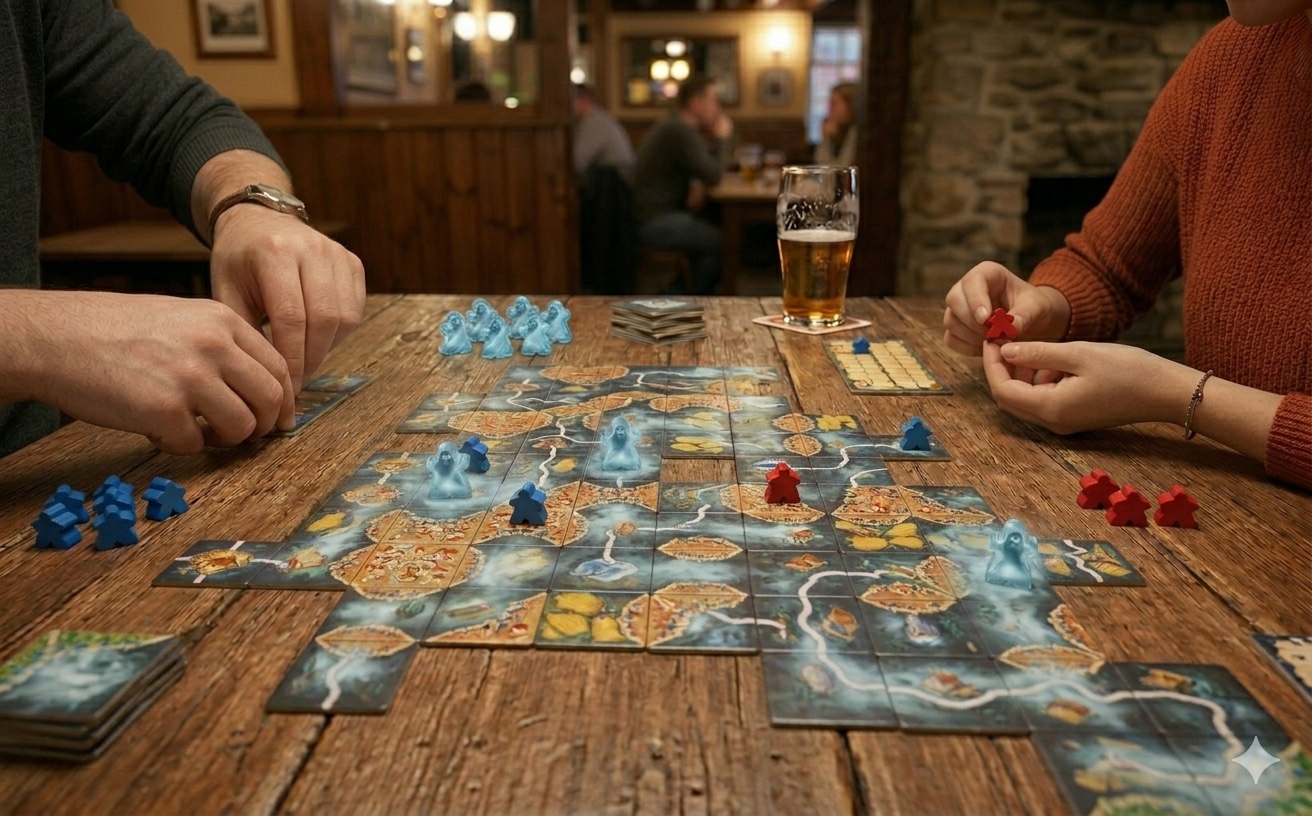
TL;DR TL;DR — Quick Summary & Key Takeaways
Mists Over Carcassonne transforms the classic competitive tile-laying game into a tense, cooperative race against ghostly fog. It delivers an accessible standalone experience with tiered difficulty levels that reward careful communication and spatial coordination.
- Standalone experience: Everything you need is in the box; you do not need the original Carcassonne base set to play.
- Cooperative mechanics: Players share the board to hit a collective point target before the ghost supply runs out.
- Tiered difficulty: Level-based scenarios ramp up challenge gradually, making it suitable for both casual groups and puzzle lovers.
- Compatible with classic: Tiles can be integrated into regular Carcassonne games as a standalone mini-expansion.
Carcassonne is one of those games that’s been on countless family shelves for over two decades, building cities and stealing roads from one another with cheerful ruthlessness. Mists Over Carcassonne takes that familiar tile-laying foundation and does something unexpected with it: it turns you all into allies, pitting the whole table against a haunted landscape crawling with ghosts. If you’ve ever wished that Carcassonne felt a little more cooperative, a little moodier, and a fair bit spookier, this one’s for you.
What Is Carcassonne?
Carcassonne is a tile-laying game where players take turns drawing a single landscape tile and placing it so its edges connect to tiles already on the table, gradually building up a shared patchwork of cities, roads, monasteries, and fields. After placing a tile, you can put one of your meeples (small wooden people) onto a feature on that tile to claim it. When a feature is completed, for example a city with all its walls closed, it scores points and the meeple returns to your supply. Whoever accumulates the most points across all their completed features wins. It’s one of the most popular and widely played board games in the world, and rightly so: the rules take minutes to learn and the decisions can be genuinely tense.
Mists Over Carcassonne keeps the tile-laying heart of the original intact, but replaces the competitive scoring race with a cooperative challenge: reach a target score together before the ghost supply runs dry.
What Is Mists Over Carcassonne?
Mists Over Carcassonne is a cooperative standalone game for one to five players, published by Hans im Glück and Z-Man Games. You don’t need to own the original Carcassonne to play it: everything you need is in the box. A typical session runs around 35 minutes, which makes it a comfortable fit for a weeknight game or a lighter Saturday afternoon. You can find full details, ratings, and the community rulebook over on BoardGameGeek.
The premise is atmospheric and immediately engaging. The lands of Carcassonne are blanketed in mist, and the landscape is overrun with ghosts that the players must work together to banish. Everyone wins together or loses together, which changes the entire character of the game compared to its competitive cousin.
What Comes In The Box
The components are clean and well presented, with the art leaning into a cooler, mistier palette than the sunny original. Here’s what you’ll find:
- A large stack of landscape tiles, some of which are marked with ghost symbols indicating where haunting occurs when they’re placed.
- A supply of ghost meeples in translucent white, which are placed onto the landscape during play.
- A set of coloured player meeples for each player to place on features.
- A score track board to record the team’s shared victory points.
- A set of level cards that define the rules for each scenario in the campaign, letting you start simple and add complexity as you progress.
- The usual rulebook, which is concise and clearly illustrated.
Setting Up
Setup takes about five minutes once you’re familiar with the game. Work through these steps to get started:
- Choose a level card and read its special rules, starting with Level 1 if it’s your first game.
- Place the starting tile face up in the centre of the table.
- Shuffle the landscape tiles face down into a single draw pile.
- Give each player their set of coloured meeples.
- Place the ghost meeple supply within reach of all players.
- Place the score track board nearby and set the marker to zero.
Higher levels introduce additional tile types and extra rules, so it’s genuinely worth starting at Level 1 to learn the ghost mechanic before the game adds further wrinkles.
How A Turn Works
Each turn follows a simple sequence that builds on classic Carcassonne’s rhythm while layering in the cooperative ghost element.
- Draw a tile from the top of the face-down pile.
- Place the tile adjacent to any tile already on the table, making sure all shared edges match (city to city, road to road, field to field).
- Optionally place a meeple from your supply onto a feature on the tile you just placed, as long as that feature isn’t already claimed.
- Resolve any ghosts on the tile: if the tile has ghost symbols, take that many ghost meeples from the supply and place them on the indicated features. Placing the new tile so that it extends an existing mist bank reduces the number of ghosts placed by one. If the supply ever runs out of ghosts and you need to place one, the team loses immediately.
- Check for completed features: a city whose walls are fully enclosed, a road with both ends capped, or a monastery surrounded by eight tiles counts as complete. Meeples on a completed feature return to their owners’ supplies. Here’s the key decision: you can take the victory points, or instead banish up to three ghosts from any mist tile of your choice, but not both. Mist banks complete separately, when they’re fully enclosed with no open edges remaining, returning all their ghosts to the supply at once.
- Pass the turn clockwise and repeat until the tile pile is exhausted or the team reaches the target score.
The win condition scales by level: Level 1 requires 50 victory points, rising to 120 at the highest levels. If the tiles run out before you hit the target, the team loses.
Managing The Ghosts
The ghost mechanic is what makes Mists Over Carcassonne feel distinct, and it’s the source of most of the tension at the table. Ghosts live exclusively on mist, which is an overlay that covers roads and fields on certain tiles (never cities). The underlying road or field still connects normally to adjacent tiles; mist is simply draped on top, adding ghosts to that part of the landscape. When a mist tile is placed, you take ghost meeples from the supply and place them onto the mist shown on it. The ghost meeples come from a shared supply, and the team’s primary lose condition is blunt: if you ever need to place a ghost but the supply is empty, the game ends and everyone loses immediately.
This makes every ghost placement feel weighty. Each one is a resource leaving the pool, and with only so many in the box, the team can’t afford to let the mist build up unchecked.
The main way to return ghosts to the supply is to complete a mist bank: a connected group of mist features that becomes fully enclosed with no open edges remaining, in the same way a city completes when its walls close. When a mist bank completes, all its ghosts are returned to the supply at once. Beyond that, the scoring decision is where the real tension lives. Whenever you score a completed road, city, or monastery, you must choose: take the victory points, or banish up to three ghosts from any one mist tile instead. You don’t get both. Points are how you win, but a depleted ghost supply is how you lose, so every scoring moment is a genuine dilemma.
Tile placement also shapes how many ghosts appear in the first place. If you place a mist tile so that it extends an existing mist bank on the board, you place one fewer ghost than the tile would normally require. Planning your placements to expand mist banks while also closing them off to complete them is where most of the cooperative discussion happens.
The Levels And Replayability
One of the most thoughtful additions in Mists Over Carcassonne is its level system. The game ships with a structured campaign of progressively harder scenarios, each introduced by a level card that adds a new rule or a new tile type to the existing foundation.
Early levels teach the core loop in a forgiving environment. Later levels introduce mechanics like additional ghost triggers, cemeteries that attract extra ghosts, and hound tiles that can banish multiple ghosts at once, all of which demand much tighter coordination. The campaign gives the game a natural arc: you can play through it over multiple sessions, and the increasing difficulty keeps it from feeling stale. Even once you’ve completed the full campaign, the replay variability in tile draws means no two games play out identically.
Player Count And Who It Suits
Solo play is a genuine option and works well: you manage a set of meeples across multiple colours, making all the decisions yourself, with the shrinking ghost supply providing the pressure that would otherwise come from a ticking clock or a competitive opponent.
Two players is arguably the sweet spot for cooperative puzzle fans. There’s enough meeple flexibility to manoeuvre around the ghosts without the table talk becoming unwieldy, and the shorter setup and play time suits a quick evening game.
Three to five players opens up more discussion and more meeples on the board, which means more options for completing features but also more competing priorities to negotiate. Larger groups tend to enjoy the social aspect of debating where to place each tile, though it can slow the pace slightly.
In terms of who’ll enjoy it: Mists Over Carcassonne is an excellent entry point into cooperative gaming for anyone who already knows the original. It’s also a solid gateway game for people new to board gaming entirely, since the tile-matching rules are intuitive and the loss condition is easy to understand. Fans of heavier cooperative games like Pandemic may find it a touch light, but that’s a feature as much as a drawback: sometimes you want a cooperative experience that doesn’t demand a two-hour rulebook session first.
Verdict And Rating
Mists Over Carcassonne is a clever reskin of a beloved classic that earns its place as a standalone game rather than just a variant. I particularly enjoy playing Carcassonne cooperatively for the first time ever and it feels well balanced. The tension between ghosts building up on the board and points needing to be increased before running out of tiles makes for a game where strategy as a group is essential. If you have any fondness for the original Carcassonne, or you just want to try something different, this is an easy recommendation: I rate it 8.5 out of 10.
Wrapping Up
Mists Over Carcassonne proves that a well-chosen cooperative twist can breathe new life into a classic formula. The ghost pressure, the shared decisions, and the levelled structure all combine into something that feels fresh without abandoning what made Carcassonne great in the first place. Whether you’re introducing a partner to cooperative games or looking for something approachable to bring to a family games night, this one is well worth pulling off the shelf. Happy haunting!