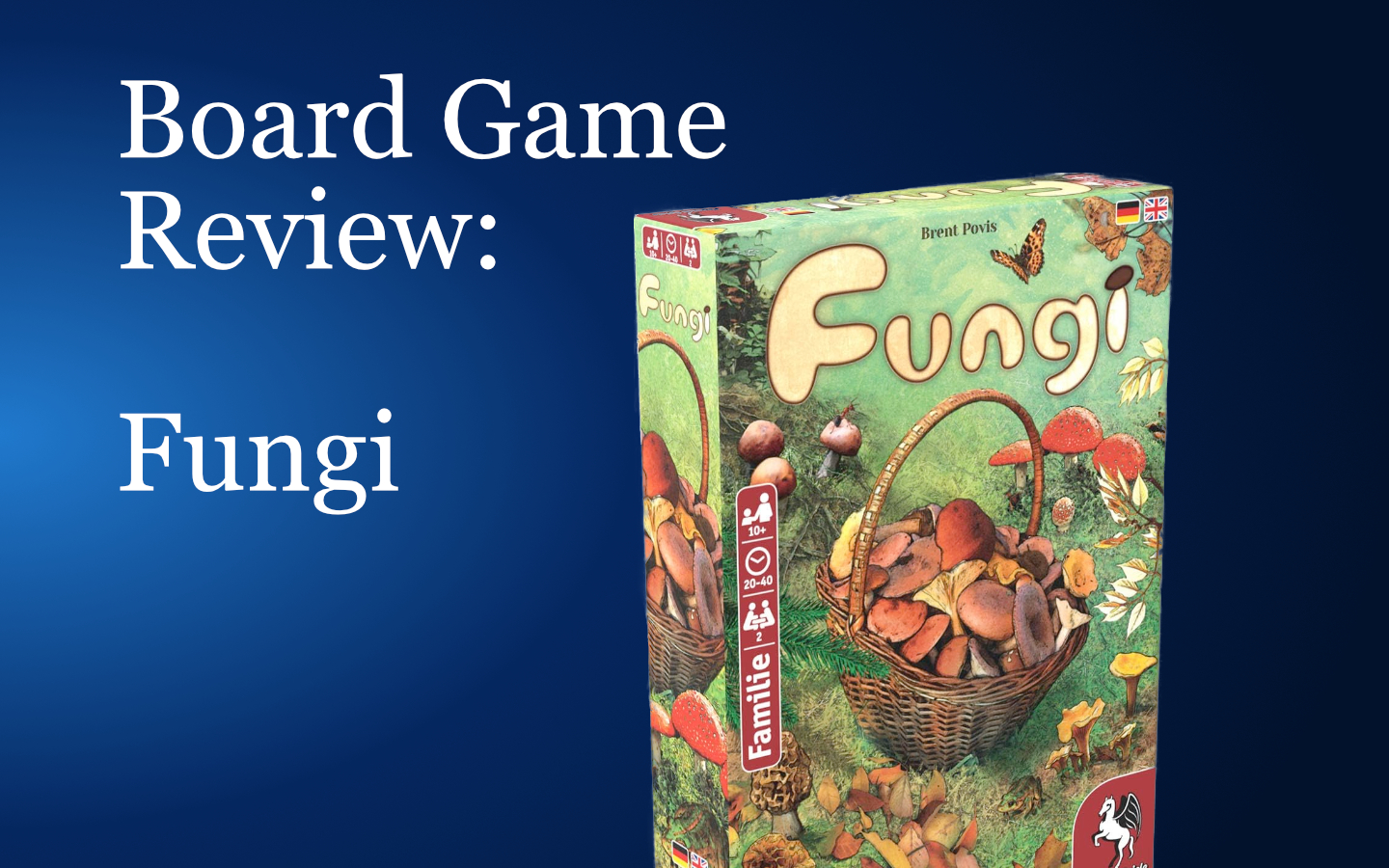
Here’s a game my wife and I enjoy, imagining we’re a real life Radagast the Brown, strolling through a dusky forest, foraging for supper and cooking it over a campfire. Fungi offers this in a cosy two‑player card game that mixes simple rules with hand management and careful strategy to keep things interesting. If you mostly play with two players, this one comes in a small box and deserves a spot on your games shelf.
What Is Fungi
Fungi is a two‑player set collection and hand management card game about collecting and cooking mushrooms. You will draw from a long path of Forest cards representing various tasty or deadly fungi, collect mushrooms of the same type, cook them in pans for points, and occasionally season your dish with butter or cider. Despite its simplicity, the continuous change in what’s available and the decay pile system keep decisions engaging. The art is beautiful, with lovely illustrations and Latin names shown for the mushrooms. It plays in around 30 minutes, is suitable for ages 10 and up, and can be enjoyed as a friendly stroll or a more cutthroat tussle.
Why Two‑Player Games Like This Shine
When you only have two players, games designed specifically for two tend to feel tighter, faster, and more interactive. Fungi leans into that with open information, tempo pressure from the decay pile, and meaningful hand management that is directly influenced by what your opponent is doing. It is quick to teach, rewards paying attention, and provides plenty of replayability without rules bloat.
What Comes In The Box
All the components of the game are standard sized playing cards, but there are a number of different piles to be aware of:
- A day deck of 84 cards that includes ten different types of mushrooms, night cards, cooking pans, baskets, cider, and butter. These have a lighter coloured back to the cards.
- A night deck with 10 cards, one per mushroom, representing double the value of the equivalent day-time mushroom. These have a darker colour back to the cards.
- A pile of stick cards which allow you to grab mushrooms a bit further away from you.
- A pair of shoes as a reminder of your current position in the forest.
- Three rule reminder cards per player.
Setup In A Few Minutes
You can be foraging in no time. Follow these steps one-by-one:
- Remove 2 pan cards from the day deck and put one in front of each player, ready for cooking.
- Shuffle the remaining of the day deck into a face‑down draw pile.
- Reveal 8 cards in a single row to the side of the day deck to create the forest.
- Deal out 3 cards from the day deck to each player.
- Place the pair of shoes in front of the two cards in the forest furthest from the day deck.
- Shuffle the 10 night deck cards and place face down out of the way.
- Reserve space on the table for a decay pile and a discard pile, near the end of the forest with the shoes.
Each player then needs to check their 3 cards and ensure they deal with these cards if they have them:
- If you have any baskets, place them alongside your already-revealled pan and note that you now have a permanent uplift in your hand limit (more on this below).
- If you have any moons, place them in the discard pile and draw a card from the night deck into your hands.
- If you have any fly agaric cards, these would normally poison you, but you can instead discard it without penalty.
Hand Size
At no point are you ever allowed to take an action that would result in you having more cards in your hand than the hand size. The default size is 8 cards, but this increases by 2 permanently for every basket you’ve collected. Additionally, fly agaric cards reduce your hand size by 4 each for the turn you collect them and your following turn before being sent to the discard pile and the effect wearing off.
How A Turn Flows
Each turn is brisk and structured, with the forest constantly moving on. Let’s go over the two stages to your turn.
During your turn, take one action only from the following:
- Place a pan down ready for a future cook.
- Sell two or more mushrooms of the same type.
- Cook three or more mushrooms of the same type, but only if you have an empty pan ready to cook them in.
- Pick up one of the two cards in front of the shoes into your hand.
- Pick up all the cards from the current decay pile, remembering that your hand limit can never be exceeded by an action you take.
After your selected action from above, you must do all of the following:
- Move the forest card closest to the decay pile into the pile.
- If this is the fifth card going into the decay pile, remove the four already present and place them in the discard pile first.
- Slide all the forest cards towards the shoes, leaving gaps near the day deck.
- Fill the gaps with cards from the day deck so that the forest has 8 cards again.
Clarifications On Turn Options
- When you sell two or more mushrooms you will receive the number of stick cards shown in the score panel for those mushrooms. For example, if the panel says 2 sticks and you sold 3 mushrooms, you get 6 sticks.
- When you cook four or more mushrooms, you can optionally also add butter to the cook. Five mushrooms allows you to add cider if you have it in your hand. You can put two additional ingredients in the pan, but only if you have enough mushrooms to allow them both separately.
- When you pick up cards from the forest, they can be from deeper into the forest than the shoes are currently, but that requires the use of sticks.
Special Card Effects
Various cards in the game have special effects. Some of these have already been covered, but let’s go over them all in one place in this section.
Pan Cards
Once in your hand, you can use a turn to place them out ready to receive mushrooms to create a tasty meal. There are no other special effects. Make sure you have enough to cook all the mushrooms you want, but don’t over-invest in them. It takes a turn to collect them, a turn to place them, and then another to fill them with mushrooms, so it’s an expensive process.
Moon Cards
When you pick up a moon card, you’re taking a lucky dip on the night deck by discarding it immediately and collecting your replacement night card. The reason you probably want to do this is that the night cards are worth double points when cooked and double sticks when sold. The down-side, of course, is that you might not have been collecting that type of mushroom and now you have a card taking up space in your hand that you cannot easily get rid of.
Fly Agaric Cards
Speaking of getting rid of cards. The fly agaric card is poison and it reduces your hand limit by 4 for each one that’s currently taking effect. When you receive a fly agaric card, put it on display in front of you and immediately assess the size of your hand. Once you reduce your hand limit by 4, discard cards that bring you down to that limit. That new limit remains in place for the rest of this turn and throughout your next turn. You can discard the fly agaric and its effect on your hand size when your second turn with it has ended.
While this card is intended to be a penalty, bear in mind that it presents an opportunity to clean up any space-hogging cards you’ve collected by accident.
Basket Cards
When you collect a basket card, it immediately goes into your display alongside pans you’ve played. From now on in the game, your hand size is 2 higher than it was before. There is no limit to how many baskets you can collect.
Stick Cards
When you sell mushrooms in pairs or higher, you receive sticks from the pool of sticks available, up to the number shown on the mushroom card score panel. When you are picking up new cards from the forest, you can now take cards beyond those directly in front of the shoes. If you want to reach the third card in the forest, you use one stick to reach to the side of the shoes. If you want, you can pick up the eighth card in the forest, next to the day deck, but it will take six sticks to do so.
Used sticks go back in the pool of available sticks as they were after the setup of the game.
End Of The Game And Scoring
The game only has one end-point. When all the day deck cards have been into the forest and either picked up or decayed, the game is over and it’s time to calculate scores.
Scoring is really simple. Look at each dish that has been cooked in a pan and add up the flavour points in the mushroom card score panels. Rarer mushrooms usually are worth more flavour points per mushroom. Butter and cider also add extra flavour points to the dish if they are present.
Add up all the dishes each player has cooked and the one with the highest flavour points is declared the winner!
Price Check And Value
You should not need to pay over £10 for Fungi. Recent prices range from £9 at the low end but some are as high as £13.49, so select your retailer carefully. At under £10 for a beautiful, quick, and replayable two‑player game, the value proposition is excellent.
Verdict And Rating
Fungi is a lovely two‑player experience that is quick to set up, easy to teach, and surprisingly strategic thanks to its decay system and hand management. It looks great on the table, plays in half an hour, and works whether you want a gentle ramble or a cheeky duel for the choicest chanterelles. If you specifically want a two‑player game, I rate it 7.5 out of 10.
Wrapping Up
If you fancy a cosy walk in the woods without leaving the table, Fungi delivers a charming set‑collection duel with just enough bite to keep you thinking. Expect under‑£10 pricing, elegant rules, and table‑ready art that makes every cook feel deliciously earned. If this sounds like your kind of evening, give it a try and see how your foraging and timing stack up against your favourite opponent.